Hadrian’s Villa (Villa Adriana) near Tivoli is a vast archaeological site rather than a single building. The monuments listed by the managing body are the Pecile wall, the Canopus, the Maritime Theatre, the Piazza d’Oro, the Large and Small Baths, the Hall of the Philosophers, the Libraries, the Imperial Triclinium and the Hospitalia. The villa once covered at least 120 hectares, and around 40 hectares can be visited today. Check the opening hours before you plan your day.
What are the main monuments at Hadrian’s Villa?
The official page of the Villae institute, which manages the site, names the following monuments. Descriptions here stay deliberately short; use the information panels on site for the details of each structure.
| Monument | Italian name |
|---|---|
| Pecile wall | Muro del Pecile |
| Canopus (the semicircular end of the water basin) | Emiciclo del Canopo |
| Maritime Theatre | Teatro Marittimo |
| Golden Square | Piazza d’Oro |
| Large Baths | Grandi Terme |
| Small Baths | Piccole Terme |
| Hall of the Philosophers | Sala dei Filosofi |
| Libraries | Biblioteche |
| Imperial Triclinium (dining hall) | Triclinio Imperiale |
| Hospitalia (guest quarters) | Hospitalia |
The Canopus
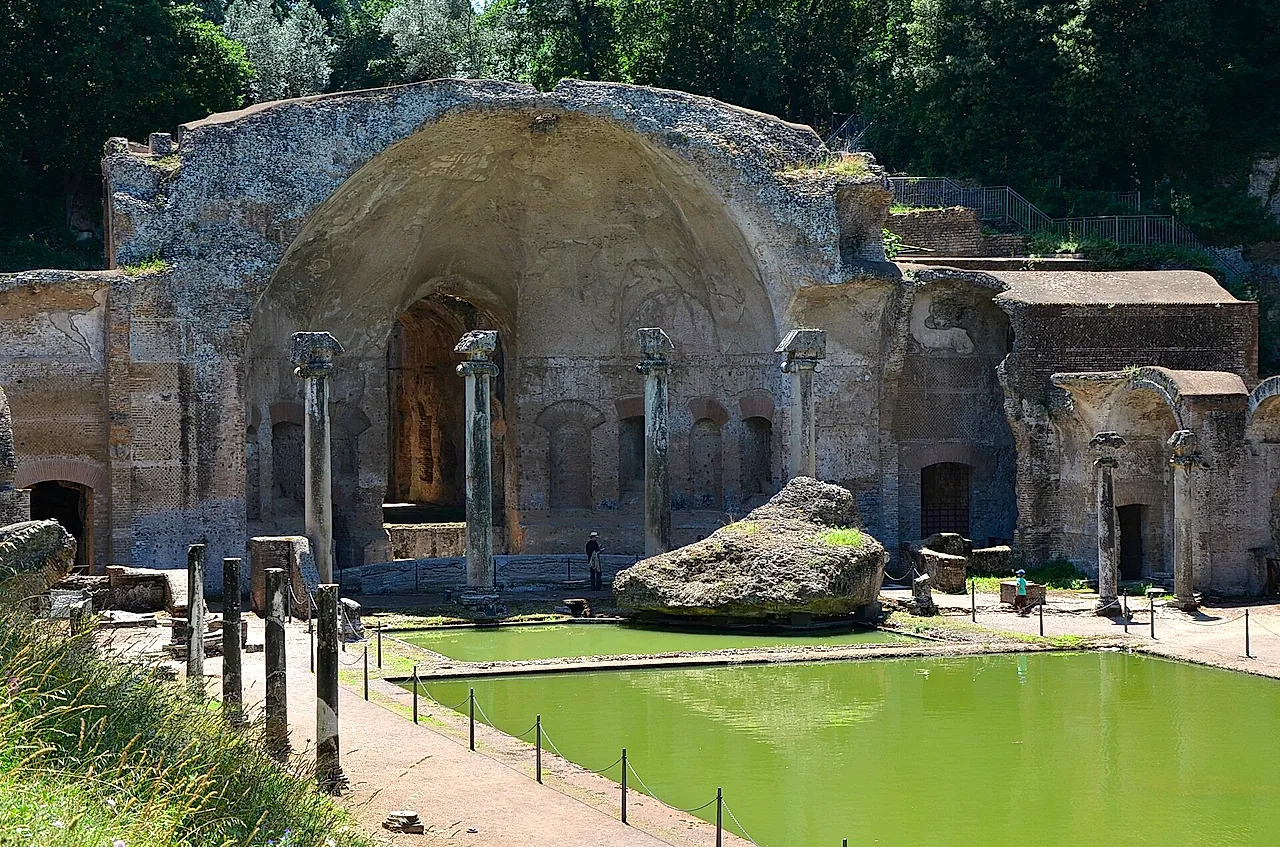
The official list refers to the Canopus as the Emiciclo del Canopo, the semicircular structure of the Canopus area. It is a natural stop for photographs.
The Maritime Theatre
The Maritime Theatre (Teatro Marittimo) is listed among the key monuments. It is named in the official list, so include it in your route even if you are short on time.
The Pecile and the Piazza d’Oro
The Muro del Pecile is the wall of the Pecile area, and the Piazza d’Oro (Golden Square) is another of the official highlights. They sit well together in a visit because both belong to the monumental part of the complex.
The Large and Small Baths
Hadrian’s Villa has two bath complexes, the Grandi Terme and the Piccole Terme. Seeing both lets you compare the larger and the smaller structure.
Hall of the Philosophers, Libraries, Imperial Triclinium and Hospitalia
These four are the remaining monuments on the official list: the Sala dei Filosofi, the Biblioteche, the Triclinio Imperiale and the Hospitalia. Together they give a sense of the residential and social life of a villa that worked like a small city.
Are there museums and a scale model?
Yes. The site has museums (the Mouseia) and a scale model (Plastico). They are open on a separate, slightly shorter schedule than the archaeological area, so check the monthly table in our visit tips. A scale model is a useful first stop on a site this large, because it shows how the pavilions relate to each other before you start walking.
In what order should you see Hadrian’s Villa?
The site has no fixed official route that we could verify, so treat this as a logical sequence rather than a timetable:
- Start with the scale model and museums, which open slightly later than the gates, to understand the layout.
- Walk to the Pecile wall and the Piazza d’Oro, the monumental core of the visit.
- Continue to the Maritime Theatre, then the Large and Small Baths.
- See the Hall of the Philosophers, the Libraries, the Imperial Triclinium and the Hospitalia as the residential group.
- Finish at the Canopus, a scenic place to end, or switch it to the start if you prefer to see the most famous view first.
If you only have a short time, prioritise the Canopus, the Maritime Theatre and the Piazza d’Oro.
What should you know before you go?
- The terrain has paths and slopes, so wear comfortable, low shoes. See visit tips.
- Buy in advance if you can: ticket prices and passes are explained in our tickets guide.
- Plan your journey with getting there.
- Many visitors combine it with Villa d’Este; see Hadrian’s Villa and Villa d’Este in one day.
For the latest information, always confirm on the official Villae website.